June 27


1869 – The U.S. steamship Narragansett arrived at Key West from Cuba with several cases of yellow fever onboard. Because the disease had been contracted abroad and the Narragansett was soon heading north, the disease was not considered a threat to local shipping or residents.
1903 – The corner stone was laid for the First Congregational Church on William Street. The ceremony was conducted by the Reverend S.F. Gale, Home Missionary Superintendent for the Congregational Church of Florida.
1914 – The R.L. Polk & Company’s Key West City Directory contained 8,606 names. By using the multiple three to allow for women and children, whose names did not appear, a population of 25,818 was indicated for the city.
1934 – Frank Welters died at age 70. In 1889 he was one of the founders of the 17-piece Welters Cornet Band, which had appeared all over the state and was named Champion Band of the State.
1946 – The Monroe County polio epidemic stood at 19 cases, with four deaths. Of the four deaths, three were adults.
1994 – The number of Cuban refugees who successfully crossed the Florida Straits in 1994 surpassed the 3,656 who completed the journey in 1993. Authorities estimated that only 4 out of 10 who attempted the crossing were successful.
2001 – The Monroe County Planning Commission approved the 122-unit Tradewinds Hammocks affordable housing project to be built in a wooded area at MM101.5 behind the Tradewinds Shopping Plaza in Key Largo, despite considerable opposition to the plan.
Information compiled by Dr. Corey Malcom, Lead Historian, Monroe County Public Library, Florida Keys History Center.
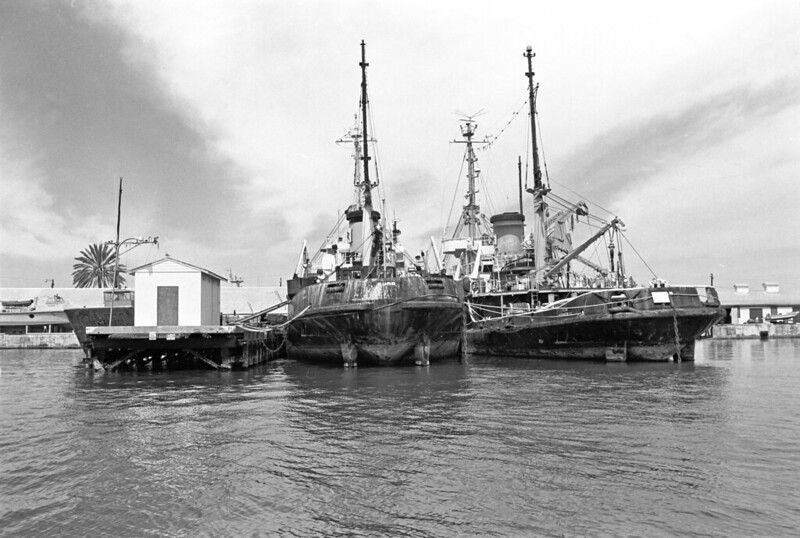
Image: Cuban refugee rafters crossing the Florida Straits for the U.S., 1994. Photo by Nancy Klingener. Monroe County Public Library, Florida Keys History Center.